


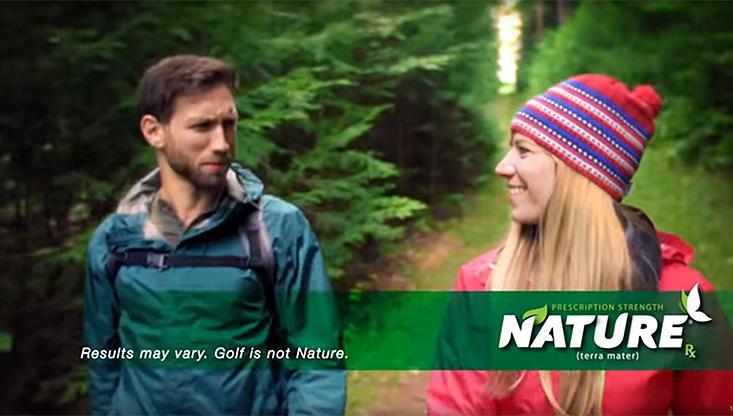
In a popular online video, Nature Rx, a depthless-eyed, rakishly bearded man prescribes nature as the drug of choice for your stress, cynicism, narcissism, and other “crippling symptoms of modern life.” There are scenes of campfires, mist-covered lakes, and much denim. “Golf is not nature,” admonishes one bit of onscreen text.
A send-up of pharmaceutical ads, Nature Rx is a genuine shoestring project, put together without major backers by four friends led by filmmaker Justin Bogardus. A former New Yorker and self-described “city guy,” Bogardus first felt the transformative power of nature on family wilderness trips as a child. He earned a master’s degree in contemplative psychotherapy at Naropa University, a Buddhism-infused institute in Boulder, Colorado, where he is a teaching assistant. “My real idea was, from a psychology background and from a filmmaking background, how do you show the kind of instinctive, unconscious value we have for nature?” he says.
Nature Rx is also a refraction of a deepening trend: the medicalization of nature. In an increasingly tech-driven global culture, with more than half of humanity living in cities and your typical North American spending 90 percent of his or her time indoors, concern has become widespread—first among psychologists, but now also parents, educators, urban planners, artists—that our disconnection from the living world comes at a high price to our health.
By the standards of nature and health research, golf absolutely is nature.
The condition to be treated, in a term coined by the writer Richard Louv in 2005, is “nature-deficit disorder,” and the symptoms are a roster of the most talked-about medical obsessions of our times, from stress and anxiety to obesity, depression, attention deficit hyperactivity disorder (ADHD), and even the desire for epidemiological self-maximization expressed by the phrase “better than well.” In each of these cases, a growing body of evidence suggests that exposure to nature can help.
That knowledge has given rise to national organizations such as the Children & Nature Network, entire fields of practice like ecotherapy and ecopsychology, and memes such as “park prescriptions,” “Vitamin N,” and “Vitamin G” (the G stands for “green”). Among specific wellness treatments, forest bathing—leisurely-yet-attentive walks through the woods—is currently trending. You’ll find it in the pages of InStyle magazine and Condé Nast Traveler. Dr. Oz recommends it, too.
But the nature prescription turns out to have troubling side effects. It risks simplifying the full spectrum of what we can experience in nature and even threatens nature itself. In fact, what we increasingly see as the cure for our modern malaise might instead be the latest symptom of it.
People have probably always believed that time spent in nature is good for the psyche. Surely it’s not for nothing that wealthy homeowners prefer views of parks and water; that we offer flowers to the bereaved; that gardens have been associated with hospitals since at least the Middle Ages. Environmental psychologists often cite Frederick Law Olmstead, best remembered as architect-in-chief of Central Park in New York City, who in 1865 wrote an early synthesis of the connection between nature and mental well-being:
It is a scientific fact that the occasional contemplation of natural scenes of an impressive character … is favorable to the health and vigor of men and especially to the health and vigor of their intellect beyond any other conditions which can be offered them.
Olmstead as good as diagnosed the nature-deficit problem as well, identifying “a class of disorders” associated with disconnection from the natural world, including “mental and nervous excitability, moroseness, melancholy, or irascibility.” But Olmstead’s claim of “scientific fact” reflected little more than widely held belief.
It wasn’t until the mid 1950s that researchers in the United States set out to study why people choose to spend time in nature, and they looked at the biggest, realest versions of it around—places like Yellowstone National Park and the remote lakes of what is now the Boundary Waters Canoe Area Wilderness in northeastern Minnesota. But there’s a reason you don’t hear about Vitamin W. The wilderness experience turned out to be rich and fulfilling, yes, but also ambiguous, unpredictable, and highly personal.
We don’t go into the wild to pursue “desired and expected outcomes,” reported the U.S. Department of Agricultural Forest Service in a 2012 review of 50 years of wilderness studies. We go for “emergent lived experiences” that “lend meaning to life.”
It took the more lab-driven approach of environmental psychology, or the study of how we relate to our surroundings, to start us down the nature-as-medicine trail.
Adventure-sports enthusiasts often speak of “type-2 fun,” which is recognized as fun only after the fact.
By the 1970s psychologists had established that people tend to prefer natural scenes to “built” landscapes. In 1979, behavioral geographer Roger Ulrich, a professor of architecture at Texas A&M University, published one of the first studies to measure nature’s impact on mental well-being. Ulrich took university students who had just finished an exam, surveyed their emotional states (they were stressed out), then had them look at 50 color slides of either urban or natural scenes before surveying the students once more. The urban scenes were tidy, clean-lined, unpeopled—like images from an architecture textbook. Nature, on the other hand, was in this case often scruffy and unspectacular, in many cases nothing but a bushy wall of green.
And still nature came out on top. A battery of studies since have produced similar findings, and competing theories have emerged as to whether the primary process at work in exposure to nature is recovery from stress, or restoration of capacity for focused attention, or both. If nature is medicine, it is the proverbial chill pill.
Our affinity for nature may well be rooted in our genes. After all, for all but the most recent millennia, human evolution took place mainly on savannas and seashores, in forests and deserts. It just wouldn’t do to have been relentlessly anxious about going camping—nature was our home.
Now researchers are finding that just the sight of nature in its ordinary, background condition—and not featuring, say, an agitated spitting cobra—acts as a cue for a positive psychological state, in the same way that the snake would trigger an immediate, unlearned negative reaction. Nature is thought waiting to be seen: “embodied cognition,” in the jargon of psychology.
Biologists tells us unthreatening nature sends an automatic calming signal to the amygdala and visual cortex in the brain, which trigger the autonomic nervous system to lower heart rate and blood pressure, decrease stress-related hormones such as adrenaline and cortisol, and boost smiley neurotransmitters such as serotonin and dopamine. The end result is a rising sensation of well-being, tranquility, vitality, and positivity.
As we learned to quantify and qualify nature’s effect on our psyches, the nature prescription became less a metaphor than a clinical reality. For example, research has suggested a daily “green dose” of urban landscaping could reduce the need for pharmaceutical medication in children with ADHD. A large photograph of a natural scene, hung for two weeks in the psychiatric patient lounge of East Alabama Medical Center, lowered the dosage of patient agitation medications at a rate that would save nearly $30,000 per year.
Yet the pursuit of nature-as-medicine has also been paradoxical, leading us away from our ancestral immersion in the wild. Research in the field typically exposes study participants to environments in a nature condition versus a human-built or non-nature condition. That doesn’t mean, however, that the nature involved is of the mud-on-your-boots variety. Often, it’s “nature.”
From Ulrich’s color slideshow onward, the apparent cure for nature-deficit disorder has been discovered largely through brief encounters with manicured urban green space, views out of windows, and representations of nature ranging from paintings to virtual reality. By the standards of nature and health research, golf absolutely is nature. As Susan Clayton, a conservation psychologist at The College of Wooster, Ohio, tells me, “Sometimes what in one study might count as the nature condition, in another study might count as the non-nature condition.”
Take an experiment described by Australian scientists in the Journal of Environmental Psychology in 2015. In it, 150 university students sat down in front of computers and were given a task that demanded their attention for more than five minutes. With their focus flagging, the students were then given a 40-second view onto either a concrete roof or a green roof planted with a flowering meadow. Even in this “micro-break,” nature proved most helpful to cognitive recovery.
The study’s results surged into the Googlesphere as a “life hack” and workplace productivity tip, even cracking the news pages at the Washington Post. Put up another checkmark for green roofs in urban settings—except that the test subjects hadn’t been offered a view out an actual window onto actual concrete or wind-dancing blossoms; instead, a Photoshopped image of one or the other of these scenes popped up on their computer monitors.
A few years ago, Peter H. Kahn, a pioneer in environmental psychology who heads the Human Interaction with Nature and Technological Systems Lab at the University of Washington, published a review of his and his colleagues’ research into the psychological effects of real window views of nature versus HDTV “window” views; of time spent with live dogs versus robotic dogs; of “telegardening” with a robotic arm via a Web interface. In every case, they found that these representations of contact with nature are better than no nature at all.
“At first glance, such a finding would speak to how we can improve human life: When actual nature is not available, substitute technological nature,” Kahn writes. But he notes that something is lost in the translation: Only the real window view eased heart-rate recovery from stress; children were more drawn to the living, breathing dog; remote-control gardening with other people was sociable, but didn’t offer much sense of connection to nature. “The human species,” Kahn concludes, “cannot achieve its full measure of sensibility and meaning apart from the natural world.”
So what’s missing in the dose-response comparison? “There’s a reduction of complexity,” says Terry Hartig, an environmental psychologist at Uppsala University in Sweden, who co-authored a seminal review of nature and health research in 2014. “You have different kinds of people in different circumstances going into different kinds of natural environments at different periods of time with differing frequency over different durations. What does this mean for change in one’s life over the life course—you know, two five-minute visits a week versus weekends spent walking away from everything else?”
What if some versions of nature prove spooky, or unappealing, or just plain boring?
Brief visits to green space can offer respite in a busy, demanding life, Hartig says, and this restorative experience has been extensively measured. But what is harder to measure is the “instorative” experience acquired by people who regularly venture into the backcountry. This experience forges skills and traits, like self-reliance and self-confidence, that stick with people and help them cope with life’s future demands.
Indeed, the nature-as-medicine approach tends to discount many experiences that are not easily classified as beneficial. Adventure-sports enthusiasts—alpinists, mountain runners, Arctic explorers—often speak of “type-2 fun,” which is recognized as fun only after the fact. Last winter I undertook a 250-mile subarctic snowshoe trek in temperatures as low as minus-60 degrees Fahrenheit. Beneficial? I’m not sure I’d use that word. Valuable? Absolutely.
Black nights and something rustling in the bushes; maggots seething in the smile of a decomposing deer’s skull: A Dutch study found that people are more likely to contemplate death in wilderness settings than in urban or cultivated natural environments. Thoughts of death may not be positive in a conventional way, but there is surely merit in the contemplation of mortality, just as there can be in fear, disgust, and discomfort. When researchers compared the experiences of visitors to a manicured botanical garden and Ireland’s Sliabh Liag sea cliffs, the park goers reported feeling calm and connected to nature, but the hikers were more likely to experience excitement, a sense of being overwhelmed, acute self-awareness, agitation, self-transcendence—a hobo’s banquet of sensations.
Ming Kuo, director of the Landscape and Human Health Laboratory at the University of Illinois at Urbana-Champaign, says that research into nature’s positive health benefits can guide planners and policymakers, and help individuals make concrete choices about their lifestyles. But Kuo acknowledges that there is a risk that people will pursue substitutes for nature, such as videos.1 When the breadth of research is taken into account, she says, nature’s role in health, like breast milk, is best viewed as holistic.
“The makers of baby formula have been working very hard for decades to make sure that formula has the same benefits as breast milk, and yet we continually find that breast milk has these amazing cognitive and health and immune-system benefits—this staggering array of benefits,” Kuo says. “You can hope to get close to substituting something else for nature that has 1 or 2 or even 70 percent of the benefits. But then at some point you have to ask, why not get 100 percent? Why not get the real thing?”
It’s that most ancient of metaphors: Mother Earth. Kahn criticizes the medicalization of nature, pointing out that we don’t apply the dose-response approach to our human networks. “Would you ask the question, ‘How much exposure does a husband need to his wife to have good outcomes: healthy heart, lower stress, mental restoration?’ ‘Do wives need different amounts or kinds of exposures to their husbands?’ ” Kahn writes in an email. “A dose is not a relationship. It’s not about co-existence. It’s not about interconnectedness.”
In fact, reducing the complex living world to a natural resource for mental health, could be bad medicine for nature itself. Birgitta Gatersleben, an environmental psychologist at the University of Surrey in England, notes that most studies into nature’s therapeutic effects have presented “nice, park-like, open environments that are almost always green, and almost always sunny.” What if some versions of nature prove spooky, or unappealing, or just plain boring? Research by Idit Shalev, a psychologist at Ben-Gurion University of the Negev, in Israel, finds that seeing or even imagining a desert can constrain the mental wherewithal to change habits like procrastination, overeating, and smoking. “An arid landscape is an embodied signal for need for energy conservation,” she writes.
In the Netherlands, where large tracts of former farmland are being converted into parks, surveys show residents prefer the land wild—except in the case of dense forests, which studies have shown cause anxiety, rather than soothe it. As a result, Gatersleben says, in some cases undergrowth and trees are being cleared to create spaces that feel safe for people. Efforts to reforest unused agricultural land in the United Kingdom have similarly met with resistance from a public that favors more open landscapes.
“There are these questions that need to be answered in order to create spaces that are good for biodiversity but maybe not necessarily good for people, and the other way around,” says Gatersleben.
In fact, look closely at the green and pleasant landscape that dominates the literature of environmental psychology, and it’s hard to ignore the resemblance to the troubled planetary ecosystem we know today: biodiversity reduced and simplified; large or dangerous animals generally absent; and nature ever more frequently experienced on YouTube or the National Geographic Channel.
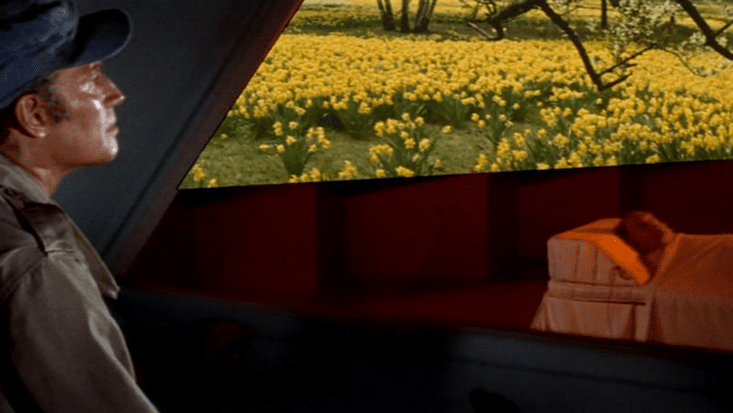
In the 1973 sci-fi film, Soylent Green, Sol, an elderly bookworm who helps solve crimes in the crowded, violent New York of 2022, gives up on life and makes his way to a euthanasia center. There, he is clinically put to death while being comforted by IMAX-style videos of the natural world: a field of tulips, deer in a forest, birds in silhouette against a falling sun.
As Sol lies dying, his friend Thorne, a police detective, breaks into the clinic to bid farewell. Thorne is nearly dumbstruck by the images playing before his eyes. “How could I know?” he says, his cheeks wet with tears. “How could I ever imagine?” The detective had never seen anything like it. Nature was a comforting therapy, but that hadn’t stopped humans from destroying the real thing.
J.B. MacKinnon writes on the environment, outdoors, consumerism, and other topics. His most recent book is The Once and Future World: Nature As It Was, As It Is, As It Could Be.

